Wednesday, May 30, 2012

Achaemenid Architecture Gets a Cameo in Marvel's Avengers

By now, most people on this planet, and perhaps even inhabiting this region of the galaxy, have seen or are at least aware of The Avengers, the Joss Whedon directed juggernaut (see what I did there?) destroying Box Office records the world over.  However, there was one brief moment that I, and perhaps a few others who are far nerdier than most, noticed.  Spoilers ahead, in case there is one soul left who hasn't seen the movie:


The scene in Stuttgart, Germany, where Loki appears at some generic Gala event where wealthy people cloister to drink and be wealthy together, seems to be taking place around a distinctive piece of Achaemenid Architecture: A Bull Capital.  This style of capital is a prevalent and recognizable motif in Achaemenid Architecture seen in palace and government buildings such as, for example, at the palace complex of Persepolis.  Depicted below is an example of such a capital:

(image source: Wikipedia)

And here is the set piece used in The Avengers:

(image source: Marvel's The Avengers)

This just goes to show there really is something for everyone in The Avengers!

Tuesday, March 13, 2012

The Bactrian Documents vol I and II

The Bactrian Documents, translated by Nicholas Sims-Williams, are valuable, first hand documents written in the Bactrian language pertaining to everyday life in pre-Islamic Bactria.  The documents can vary from being as important as Buddhist texts or legal/marriage contracts to receipts for goods purchased and received from one person to another.  While the marriage contract is interesting to read, I honestly find the receipts to be very interesting and even slightly amusing to read.  It makes me chuckle to think of reading someone's old grocery shopping receipt from the Kushan era and finding that people back then shopped for things not so different than what we shop for today.  Such as in Document B:

"The year 137, the month Shabat,
There has been received by me, Aspal-bid, from you, Zuwanind, the store-keeper, what is written in the list:forty measures of flour and grain, twelve jars of wine, ten sieves, ten bags of straw, fourteen bundles of lucerne, one chicken.  So this (is) your proof (of receipt). " (1)

The contracts contained herein are also fascinating.  Document A is a marriage contract, wherein a woman named Ralik is married to brothers,  Bab and Piduk.  I'm not sure how common it was for one woman to be married to two men.  The reading here seems to be pretty clear on the matter, though:
"Now:There has been requested by me, Bag-farn, from you, Far-wesh, and from you, Nog-sanind, this woman whose name (is) Ralik (as) a fully privledged daughter-in-law, (as) a wife for these (my) sons, Bab and Piduk..." (2)
The document also goes on to say:
"And a declaration was made (by us), Bab and Piduk.  We have received Ralik - I, Bab, and (I), Piduk - (as) a wife (to be treated) like a wife in every home which we now have and also which we may acquire in the future, (as) a lady possessing authority, as (is) the established custom in the land." 
I immediately drew correlations in this practice here to the practice mentioned in the Bible of how Jewish men would marry the wives of their dead brothers, and any children had in that relationship would belong to the dead brother.  Mongol men would marry their stepmothers if their father died, or marry their brother's wives in order to keep the women in the family and afford them social security and protection.  This appears to be similar to that in some regard, though I wonder if both these men engaged in intercourse with her.  At least they would know someone was fathering the children, though probably not which brother was successfully producing offspring with her.

Other documents included in the volumes include contracts for sales of items and slaves.  Loan contracts were also present, describing their interest rate, penalties, and items and/or amounts of money loaned.  There are also Buddhist texts and private correspondence, as well as a few legal proclamations.  The documents bring to life the workings of an advanced, organized society.  These types of primary sources are my favorite because they demonstrate that people, living in the years approximately from 200-400 A.D, were not so different from us at all, and desired and valued similar things to modern people.  They needed clear legal rulings for property inheritence, grievances, and criminal justice.  They utilized marriage contracts to negotiate rights for newly married women and their roles in their new households.  They shopped in markets for goods to feed their families. They wrote expressive, elegant letters to one another and they wrote beautiful hymns to the Buddha.  The Bactrian Documents are a significant and integral source of information for Bactrian scholarship and crucial to understanding the rich history of this important area.


Thursday, March 8, 2012

A Quick Note on Issues in Translation

As I've been translating Ibn al-Faqih and his account of the Balkh and the Barmakids, my professor and I have always understood that Naw Bihar = New Vihara.  Vihara, of course, is the name for Buddhist temples.  In reading other translations of primary source material, however, I have noticed that other authors have translated or understood Naw Bihar to be a reference to Fire Temples aka Zoroastrian places of worship.  So far, I've been unable to understand why this happens, because as far as I can tell, there's a pretty clear difference between the translation of the name of Zoroastrian places of worship and Buddhist places of worship. Even more than that, Richard Bulliet, in his article "Naw Bahar and the Survival of Iranian Buddhism" suggests there may have been a particular strain of Iranian Buddhism, itself distinct and different from the Mahayana and Theravada schools of Buddhism.  There were many "Naw Biharas" located through Tocharistan into Iran (Iranian-speaking or Iranian-influenced places), with the name meaning "New Spring" in Persian.  Without further archaeological evidence, as Bulliet laments, there is no hard evidence for a distinctly Persian flavor of Buddhism.

On another related note to the issues of Zoroastrianism and Buddhism is the issue of the Barmakids.  Bulliet states rather plainly the notion has been dispelled in recent scholarship that the Barmakids were descended of Zoroastrian priestly origins, and rather have origins in the Buddhist priestly class, taking their name Barmak from the title of the leader of the monastery.  More than that, the Barmak probably had vast regional authority in Bactria and Tocharistan.   In my translation work of Ibn al-Faqih, I've come across a passage on a rather well-known incident, describing the indignation of the King of Kabul over the conversion of Barmak abu Barmak abu Khalid to Islam.  The king fired off a letter to the new Barmak, the son of the previous, though now-converted, Barmak, who went by the new name Abd Allah, describing his feelings over the matter, saying what amounted to "nothing good has ever come from Islam".  The leader of one Buddhist monastery in Balkh, even though highly important in its time, would not have attracted such attention of local rulers with a move like this unless his authority was more than just religious in nature.  Likely, he was a powerful temporal as well as spiritual authority, perhaps akin to a Pope or a Caliph? That is pure speculation on my part, though an educated guess, nevertheless.

Once again, I'll leave the matter of the Barmakids to another post.  For now, just remember that when looking at a translated text, what you're reading always passes through the lens of one or more translators, and their finished product may not always be a perfect mirror of the original text.


Tuesday, February 7, 2012

The Prof gets side-tracked: Alexander and Roxanna

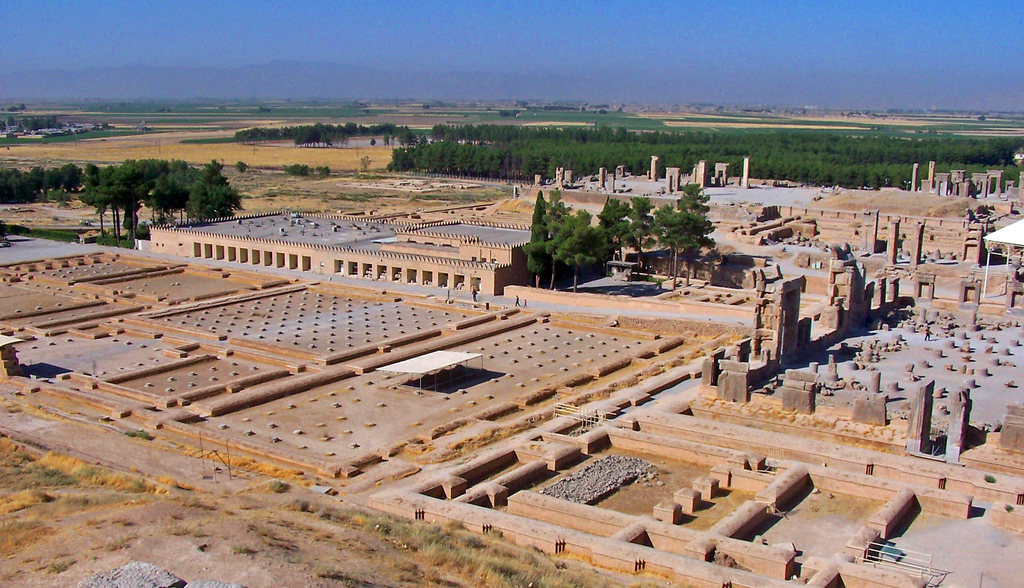
I haven't read this anywhere myself, but one day in my History of Iran class, a few students asked about the story of Alexander getting drunk and burning down Persepolis.  My professor then told us of how Roxanna, Alexander's Persian wife, got him wasted one night and he drunkenly decided it would be a good idea to burn the extensive palace complex of Persepolis to the ground.  Persepolis, as we should note, was the grandiose palace at which the Achaemenids received their yearly tribute from their Satraps and other visiting dignitaries for the Noruz (New Year) festival.


Visitors bringing tribute to the king


A broader view of Persepolis

My teacher went on to relate that after waking up from his hangover and realizing what he had done, Alexander wept bitterly for the destruction of Persepolis.  I have no idea if any of this is historically accurate or not, but it makes for an amusing story.  


Alexander and the Seleucids


At their apex under Darius I, the Achaemenids ruled an empire expanding from the Punjab to Egypt and on into Greece. Rule over this vast extent from the Mediterranean to Central Asia was highly centralized, despite the sizable empire and the various peoples living in it. The Achaemenid administration was a well-oiled machine, and though they conquered much, they were also tolerant of local traditions. This is evident in the incident of the Achaemenid king Cyrus the Great freeing the Jewish people from Babylonian capitivity and allowing them to return to Jerusalem to rebuild their temple. 

Achaemenid reign would not last, however, much to Darius III's chagrin.  The coming of Alexander across the Hellespont and into Achaemenid territory would hail the end of their empire.  Alexander's decisive victories at Granicus, Issus, and Gaugamela would seal the fate of Darius III and mark Alexander's entrance to the Central Asian front.  Alexander, who was knowledgeable of Achaemenid politics and custom, performed the burial rites for the assassinated Darius III, positioning himself as the obvious heir to throne of the Achaemenid Empire (2).  As a policy of integration and adaptation, Alexander took a Persian wife, the famous Roxanna, and strongly encouraged his generals to take local wives, which they did dutifully (3).  Alexander did not rest on his laurels here.  He conquered all the way to India, when his army would not and could not go any further.  


Alexander's conquests were impressive in scope, speed, and military genius.  However, when comparing the map the Achaemenid Empire and Alexander's holdings, it is notable that Alexander conquered nothing that the Achaemenids did not already hold.  This is not to downplay the achievement of Alexander, and it must be noted that it took several successive Achaemenid rulers to accomplish what Alexander did in a matter of years.  

Alexander was noted for founding military colonies along his conquest route, many of them bearing his name.  These colonies became seedlings from which Hellenistic cultural influence sprang into and mingled with local culture.  Syncretic deities became common place, even influencing Zoroastrianism to a small extent.  "While Alexander was later execrated for having killed large numbers of Zoroastrian clergy, Hellenism's impact on Zoroastrianism was relatively minor.  There was some syncretism and equation in images of Ahura Mazda with Zeus, or Anahita with Aphrodite in the Parthian period, but there appears to have been no changes in ideas or practice" (4).  The site of the Greek colony Ai Khanoum in Bactria on the Oxus River, had many sculptures, both small and large, as well as coins and metalware depicting Greek deities.  The buildings at this site incorporated features of a Greek polis, but with decidedly Iranian and Central Asian influences in layout and in aspects of architectural design (5).  

After Alexander's death in 326, Bactria rebelled against Greek rule, and they again rebelled in 323, only to be brought back into the control of the Seleucid Empire, under the rule of Alexander's General Seleucus (6).  The Seleucid Empire, founded by Seleucus, was to incorporate the Eastern portion of Alexander's former holdings.  Two other generals, Ptolemy and Antigonus, would rule over Western and Middle Portions, respectively. 


The Seleucids clearly made out the best on the deal, but their holdings were not nearly as centralized as the Achaemenids had been, nor was there a cult of personality and a strong army to back it up like Alexander had wielded.  The Seleucid state, faced with such a vast realm to defend, was constantly shifting its military from border to border, thus leaving the Seleucid monarchs in a position of entrusting their regional governors with great authority and autonomy of action (7).  Bactria proved to be quite problematic for the Seleucids, as it was of vital importance for its wealth and resources, particularly in pacifying the eastern holdings of the Seleucid Empire.  However, those very assets made the governors of Bactria powerful, and the Satrapy often rebelled or outright seceded from Seleucid control (8).  

The Greco-Bactrian Kingdom would break away from the Seleucids, and enjoy it's own monarchy and independence as a unique political force.  They united with the Seleucids to depose the monarch of the breakaway Parthian Satrapy, then faced invasion from the Seleucid King Antiochus III, or Antiochus the Great (9).  Antiochus re-established Seleucid control over Bactria, but he did so at the cost of recognizing the independence of Parthia (10).  However, the strain of dealing with encroaching steppe military powers in the east and Rome in the West became too much for the Seleucids.  After ruling for 182 years, the Seleucid Empire fell to the Parthian nomadic invaders (11).

Hellenism in Bactria during this time seems to have not been so much Greek dominance over local culture, but rather a fusion of Hellenism and local culture.  Greek-style sculpture had to adapt to a lack of stone, and thus clay and stucco were utilized, built upon a wooden frame.  This would be a regular style of statue-making, for it would appear in Buddhist art as well (12).  The findings at the site of Ai Khanoum in Bactria are of the most vital importance, as they indicate the city was a strategic center and heavily fortified, but also of particular importance for the art and architecture found there, indicating an adoption of Central Asian building practices, layouts, and designs, but also Greek style buildings, such as an amphitheater, and a gymnasium, both built of mud brick, but featuring Corinthian columns.  Temples located at Ai Khanoum weren't even built in the Greek style at all.  From the Encyclopedia Iranica: 

"Three temples have been discovered, none of which has a Greek plan. One of them, a simple stepped podium in open air on the acropolis, is clearly related to Iranian and Central Asian sanctuaries of the Achaemenid period. Another, standing on a three-stepped platform, with a square plan and a broad vestibule leading to a smaller cella flanked by two sacristies, and whose walls are decorated with indented recesses, is also purely Oriental and can be compared with certain Parthian temples at Dura Europos. A third temple with a triple cella has the same wall-decoration and stepped platform. Although the official pantheon, as it appears on the coinage of the Greco-Bactrian kingdom, was, with a few exceptions, purely Greek (Cl. Petitot, RN, 1975, pp. 23-57; P. Bernard, ibid., pp. 58-69; 1973, pp. 238-89; 1974, pp. 6-41; Fouilles d’Aï Khanoum IV: Les monnaies hors trésors, Paris, 1985), this type of religious architecture implies a strong influx of local beliefs in the city-cults and suggests divinities of a syncretic nature." (13)

So while the temples were not Greek in structure or plan, the pantheon was Greek in name.  These deities probably took on aspects of similar local deities, and fulfilled the duties attributed therein.  Thus a thriving, shared culture unlike any seen before or since existed at this time, with fused eastern and western ideas on art, architecture, and religion meeting.  However, this would not be the first time that Bactria would be a cultural melting pot of sorts.  Upon the arrival of the Yuezhi from the Central Eurasian Steppes, new cultural aspects would be introduced to Bactria with the establishment of the Kushan Empire.


A metal plate depicting the Greek Goddess Cybele, unearthed at Ai Khanoum.


1.  Briant, Pierre.  From Cyrus to Alexander: A History of the Persian Empire.  Eisenbrauns: Winona Lake, IN.  2002. pg. 823-832

2. Garthwaite, Gene R.  The Persians.  Blackwell Publishing: Malden, MA. 2007. pg. 69

3. Ibid. pg. 69

4. Ibid, pg. 68

5. O. Bernard. Ay Kanom. Encyclopedia Iranica Online. http://www.iranicaonline.org/articles/ay-kanom-or-a-khanum-tepe-a-local-uzbek-name-lit August 18, 2011.  Accessed February 7, 2012.

6. Grenet, Franz.  Bactria.  Encyclopedia Iranica.  http://www.iranicaonline.org/articles/bactria. August 19, 2011.  accessed February 7, 2012.

7.  Garthwaite, Gene R.  The Persians.  Blackwell Publishing: Malden, MA. 2007. pg. 71-72

8. Ibid, pg. 72

9. Ibid

10. Ibid

11. Ibid.

12.  O. Bernard. Ay Kanom. Encyclopedia Iranica Online. http://www.iranicaonline.org/articles/ay-kanom-or-a-khanum-tepe-a-local-uzbek-name-lit August 18, 2011.  Accessed February 7, 2012.

13. Ibid.

All the pictures contained herein were found through Google Image Search.


Wednesday, February 1, 2012

Early Bactrian History


I know I said in my last post that I would cover the Barmakids, however, I felt it much more important to give an introduction to and background on Bactria. Early sources claim Balkh held prominence in the earliest days of Zoroastrianism when the king of Balkh granted protection to the prophet Zoroaster.  The region was also known in antiquity to the classical historians Xenophon, Diodorus, and Herodotus.  The writer Ctesias recorded Bactria as being known to the Assyrian monarch Ninus and his wife Semarimis in the late 9th and early 8th century B.C (1).  The Assyrians and Medes probably had knowledge of the Bactrian Kingdom, as did the pre-Achaemenid Iranians kingdoms.  Diodorus gives the implication that the Bactrian kingdom "was well known for its numerous and warlike population, for its cities, fortresses and riches" (2).  When the Achaemenids embarked upon their conquest of Central Eurasia, they did so with a good idea of what they would find there.  "The Achaemenids did not found Bactra, they did not invent irrigation, they did not create the civilization of Central Asia, but they coveted its riches when their time came" (3).

The Persians and Bactrians fought to a stand-still, with neither side gaining the upper hand in the conflict.  However, the Bactrians respected Cyrus and pledged their loyalty to him, thus becoming a very important satrapy of the Achaemenid Empire.  The powerful Bactrian satrapy would act as the muscle of the empire in Central Asia, quelling rebellion in Margiana (4) and providing skilled workers, soldiers, and precious items and minerals as tribute to the Achaemenid kings.  The Bactrian satraps generally seemed to be junior princes of the royal household, and these princes commanded the loyalty of the Bactrian people, even throwing them into dynastic struggle on more than one occasion.  "It seems, therefore, that Bactria, as the political mainstay of the Achaemenids in Central Asia, was frequently the apange of princes of the blood.  This was, however, a policy which cut both ways, since the Bactrians were always willing to give armed support to the claims to the throne of their satrap who was, to some extent, their 'suzerain'.  Nevertheless, the Achaemenid rulers found this policy successful since their younger brothers could find an outlet for their frustrations..." (5).

This brief, essential summary of Bactrian contributions to the Achaemenids brings us up to through the Achaemenid era, and next we'll venture into the Hellenistic Era, wherein the Greeks leave their mark upon the rich landscape of the Bactrian region.

Citations:

1.  Grenet, Franz.  Bactria.  Encyclopedia Iranica.  http://www.iranicaonline.org/articles/bactria. August 19, 2011.  accessed February 1, 2012.

2. Francroft, Henri- Paul. The Cambridge Ancient History vol. 4: Persia, Greece, and the Western Mediterranean. ed. John Boardman, N.G.L Hammond, D.M Lewis, M. Ostwald.  University of Cambridge: Cambridge. 1988. pg. 169

3. Ibid.

4. Ibid. pg. 171-172

5. Ibid. pg. 174


Friday, January 27, 2012

Please allow me to introduce myself. I'm a woman with obscure tastes.

This blog, somewhat inspired by a former professor of mine, is meant to be a nice way for me to stay on top of my research for my independent study project.  The aim of my project is to study Buddhist and Islamic interactions from the Pre-Islamic to the Post-Islamic conquest of Bactria aka Balkh, located in what is now Afghanistan and part of Tajikistan.  I'll be covering background research of the area of Bactria and neighboring Tocharistan, and working my way down through the Achaemenid Empire to the Abbasid Caliphate, touching on major points in between.  The main focus of this study, however, is the Buddhist and Islamic interactions.

For the primary sources of my research, I am currently reading relevant portions of Ibn al-Faqih's observations of Balkh.  Tenth century Arabic literature is not easy to translate, but my professor and I are slowly making our way through this text.  In the meantime, I have recently been reading about the Barmakids, a powerful Bactrian family that, though descended from prominent Buddhist leaders, converted to Islam and rose to extraordinary prominence during the Abbasid Caliphate.  Though the family fell from favor in 803, their adaptability and longevity is noteworthy and fascinating.  I'll be talking more about them in my next update.