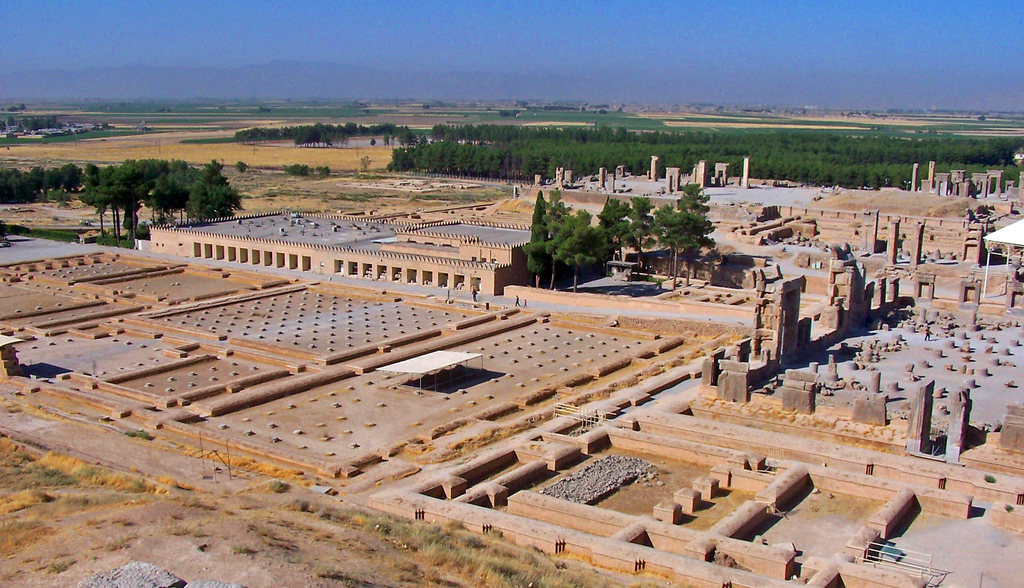
At their apex under Darius I, the Achaemenids ruled an empire expanding from the Punjab to Egypt and on into Greece. Rule over this vast extent from the Mediterranean to Central Asia was highly centralized, despite the sizable empire and the various peoples living in it. The Achaemenid administration was a well-oiled machine, and though they conquered much, they were also tolerant of local traditions. This is evident in the incident of the Achaemenid king Cyrus the Great freeing the Jewish people from Babylonian capitivity and allowing them to return to Jerusalem to rebuild their temple.
Achaemenid reign would not last, however, much to Darius III's chagrin. The coming of Alexander across the Hellespont and into Achaemenid territory would hail the end of their empire. Alexander's decisive victories at Granicus, Issus, and Gaugamela would seal the fate of Darius III and mark Alexander's entrance to the Central Asian front. Alexander, who was knowledgeable of Achaemenid politics and custom, performed the burial rites for the assassinated Darius III, positioning himself as the obvious heir to throne of the Achaemenid Empire (2). As a policy of integration and adaptation, Alexander took a Persian wife, the famous Roxanna, and strongly encouraged his generals to take local wives, which they did dutifully (3). Alexander did not rest on his laurels here. He conquered all the way to India, when his army would not and could not go any further.

Alexander's conquests were impressive in scope, speed, and military genius. However, when comparing the map the Achaemenid Empire and Alexander's holdings, it is notable that Alexander conquered nothing that the Achaemenids did not already hold. This is not to downplay the achievement of Alexander, and it must be noted that it took several successive Achaemenid rulers to accomplish what Alexander did in a matter of years.
Alexander was noted for founding military colonies along his conquest route, many of them bearing his name. These colonies became seedlings from which Hellenistic cultural influence sprang into and mingled with local culture. Syncretic deities became common place, even influencing Zoroastrianism to a small extent. "While Alexander was later execrated for having killed large numbers of Zoroastrian clergy, Hellenism's impact on Zoroastrianism was relatively minor. There was some syncretism and equation in images of Ahura Mazda with Zeus, or Anahita with Aphrodite in the Parthian period, but there appears to have been no changes in ideas or practice" (4). The site of the Greek colony Ai Khanoum in Bactria on the Oxus River, had many sculptures, both small and large, as well as coins and metalware depicting Greek deities. The buildings at this site incorporated features of a Greek polis, but with decidedly Iranian and Central Asian influences in layout and in aspects of architectural design (5).
After Alexander's death in 326, Bactria rebelled against Greek rule, and they again rebelled in 323, only to be brought back into the control of the Seleucid Empire, under the rule of Alexander's General Seleucus (6). The Seleucid Empire, founded by Seleucus, was to incorporate the Eastern portion of Alexander's former holdings. Two other generals, Ptolemy and Antigonus, would rule over Western and Middle Portions, respectively.

The Seleucids clearly made out the best on the deal, but their holdings were not nearly as centralized as the Achaemenids had been, nor was there a cult of personality and a strong army to back it up like Alexander had wielded. The Seleucid state, faced with such a vast realm to defend, was constantly shifting its military from border to border, thus leaving the Seleucid monarchs in a position of entrusting their regional governors with great authority and autonomy of action (7). Bactria proved to be quite problematic for the Seleucids, as it was of vital importance for its wealth and resources, particularly in pacifying the eastern holdings of the Seleucid Empire. However, those very assets made the governors of Bactria powerful, and the Satrapy often rebelled or outright seceded from Seleucid control (8).
The Greco-Bactrian Kingdom would break away from the Seleucids, and enjoy it's own monarchy and independence as a unique political force. They united with the Seleucids to depose the monarch of the breakaway Parthian Satrapy, then faced invasion from the Seleucid King Antiochus III, or Antiochus the Great (9). Antiochus re-established Seleucid control over Bactria, but he did so at the cost of recognizing the independence of Parthia (10). However, the strain of dealing with encroaching steppe military powers in the east and Rome in the West became too much for the Seleucids. After ruling for 182 years, the Seleucid Empire fell to the Parthian nomadic invaders (11).
Hellenism in Bactria during this time seems to have not been so much Greek dominance over local culture, but rather a fusion of Hellenism and local culture. Greek-style sculpture had to adapt to a lack of stone, and thus clay and stucco were utilized, built upon a wooden frame. This would be a regular style of statue-making, for it would appear in Buddhist art as well (12). The findings at the site of Ai Khanoum in Bactria are of the most vital importance, as they indicate the city was a strategic center and heavily fortified, but also of particular importance for the art and architecture found there, indicating an adoption of Central Asian building practices, layouts, and designs, but also Greek style buildings, such as an amphitheater, and a gymnasium, both built of mud brick, but featuring Corinthian columns. Temples located at Ai Khanoum weren't even built in the Greek style at all. From the Encyclopedia Iranica:
"Three temples have been discovered, none of which has a Greek plan. One of them, a simple stepped podium in open air on the acropolis, is clearly related to Iranian and Central Asian sanctuaries of the Achaemenid period. Another, standing on a three-stepped platform, with a square plan and a broad vestibule leading to a smaller cella flanked by two sacristies, and whose walls are decorated with indented recesses, is also purely Oriental and can be compared with certain Parthian temples at Dura Europos. A third temple with a triple cella has the same wall-decoration and stepped platform. Although the official pantheon, as it appears on the coinage of the Greco-Bactrian kingdom, was, with a few exceptions, purely Greek (Cl. Petitot, RN, 1975, pp. 23-57; P. Bernard, ibid., pp. 58-69; 1973, pp. 238-89; 1974, pp. 6-41; Fouilles d’Aï Khanoum IV: Les monnaies hors trésors, Paris, 1985), this type of religious architecture implies a strong influx of local beliefs in the city-cults and suggests divinities of a syncretic nature." (13)
So while the temples were not Greek in structure or plan, the pantheon was Greek in name. These deities probably took on aspects of similar local deities, and fulfilled the duties attributed therein. Thus a thriving, shared culture unlike any seen before or since existed at this time, with fused eastern and western ideas on art, architecture, and religion meeting. However, this would not be the first time that Bactria would be a cultural melting pot of sorts. Upon the arrival of the Yuezhi from the Central Eurasian Steppes, new cultural aspects would be introduced to Bactria with the establishment of the Kushan Empire.
A metal plate depicting the Greek Goddess Cybele, unearthed at Ai Khanoum.
1. Briant, Pierre. From Cyrus to Alexander: A History of the Persian Empire. Eisenbrauns: Winona Lake, IN. 2002. pg. 823-832
2. Garthwaite, Gene R. The Persians. Blackwell Publishing: Malden, MA. 2007. pg. 69
3. Ibid. pg. 69
4. Ibid, pg. 68
6. Grenet, Franz. Bactria. Encyclopedia Iranica. http://www.iranicaonline.org/articles/bactria. August 19, 2011. accessed February 7, 2012.
7. Garthwaite, Gene R. The Persians. Blackwell Publishing: Malden, MA. 2007. pg. 71-72
8. Ibid, pg. 72
9. Ibid
10. Ibid
11. Ibid.
13. Ibid.
All the pictures contained herein were found through Google Image Search.