Tuesday, February 24, 2015

Bactrian Brief: Scammers, Hackers, and Terror! Oh My!

I watch Dr. Phil from time to time. Many of my readers have probably done so, but few will likely admit it. My favorite episodes are the ones where Dr. Phil exposes people being scammed to the scammers they are in love with/married to/associated with in some way. It is entertaining, sad, depressing, and perhaps a moment of schadenfreude for myself and other viewers as the crestfallen mark realizes that he/she has been duped out of hundreds of thousands of dollars by an email scam, usually of the infamous Nigerian variety. On a somewhat related note, the BBC posted this article describing the theft of $1 billion USD from "up to 100 banks and financial institutions" going on around the world since 2013 by hackers based in Russia, Ukraine, and China. After all the neverending headlines of money disappearing into the dark underbelly of cyberspace, I wondered if any of this money could find its way to terrorist organizations such as Boko Haram, IS, or al-Qaeda. I took my inquiries to my friend, Dr. Joshua I. James of UCD School of Computer Science and Informatics to ask him for more information on this topic.


BGB: Have you ever found a credible link between phone scamming and theft via hacking or computer fraud and Islamic Terrorist groups?

JIJ: You mean as a source of funding? Indirectly. Their main funding comes from slave trade and drugs. Hacking, etc is more mafia money. Not to say they dont do it, but it is not the main source for most groups. But groups do hack for info and intelligence. Nigerian scams may just be a way to infect someone's machine and get access to data, not only for money but also intel.

BGB: I read on the BBC recently that 1 billion USD has been stolen in what Kaspersky Labs called an "unprecedented" cyber bank robbery. What does this money go toward in these types of situations? And who is taking it?

JIJ: I've not seen the evidence so i cant say exactly, but I would guess it is either big organized crime or government sponsored. The fact that it had been going on so long means that its probably not a small operation. If so then the money will be invested into education for new hackers, and also used for drugs and other businesses.

BGB: So are there mafia type organizations that have private armies of hackers?

JIJ: Think of them like consultants: Independent hackers that specialize in something [criminal organizations] need. There are many small groups that specialize in one piece of the puzzle. For example, you need about 20 different services to start building botnets. So that's 20 small specialty hacker groups, and these groups compete for business. But, some organized crime groups have their own [in-house hackers]. Just like a normal business, really.

BGB: I was going to say, this all sounds very slick and professional.

JIJ: It is more professional than most legitimate business, and more innovative, too. That's why governments can't keep up. But does it go to fund terrorism? I've not seen a direct link, just indirect. Downloading a movie online indirectly funds terrorism. Buying a taco at Taco Bell does, too. All money is connected. But I've not seen terrorist groups like IS doing scams for cash. They can make a lot of money much easier, so they don't need to scam. Scamming is for groups that want to make money, but avoid police. IS could care less about police, obviously.


Update: Indeed, it seems, as Dr. James stated, that IS does have several diverse and heinous means of raising funds beyond that of email scams.

Dr. Joshua I. James is a research fellow at UCD Ireland. He currently resides in Seoul, South Korea, where he works with South Korean law enforcement on cybercrime and investigative methods in digital forensic research.

Tuesday, February 17, 2015

Marco Polo - Episodes 1 and 2


After many delays and procrastinations, I have finally settled down and watched the first two episodes of Netflix's Marco Polo.  I must say, so far I enjoy the series thoroughly. Netflix has managed to create a show that gives faithful deference to the source material while sprinkling in the action and drama that audiences need to stay engaged and entertained with the show.

There were several details that delighted me with the first episode, in particular a tiny moment that no one else likely gave much thought. When the Polos are crossing the Taklamakan Desert, they encounter a sandstorm that sends the caravan scrambling for cover. However, this is no ordinary sandstorm! A man, presumably a bandit, rides out of the whipping clouds of dust, looking for some travelers to pillage. He retreats into the storm, finding no quary, and the scene ends. I was losing my mind as this scene was taking place, because this is from my favorite part of the entire book of The Travels. This bandit was of the Karaunas, a band of riders quoted in The Travels as having Mongol fathers and Indian mothers. The sandstorm was a representation of a "black art" Polo described them as wielding, stating that when they mean to attack a village, they whip up a cloud of dust that goes before them to blacken the sky, keeping their movements invisible to their victims until they strike. It is a fascinating portion of Polo's narrative, and that the show would even include a visual reference to the Karaunas sold me on it instantly. I was very pleased by this.

I was also very surprised that the show was so close to The Travels in its' treatment of Polo's position as observer and information gatherer for Kublai Khan. In his time at court, Polo was able to travel over much of Kublai Khan's realm. He would then report to the Khan all that he had seen on these trips, with that information comprising mostly mercantile assets, observations of local custom and stories he heard on those travels. This intel gave Kublai valuable information that informed strategy, as witnessed in the second episode, when Kublai moved against his treacherous brother, Aric. It was very surprising to see how faithfully the show kept Polo's reports and observational skills at the forefront of his character, since such things in and of themselves are not deeply entertaining (The Travels is an informative, but not really entertaining, read). However, the show was able to incorporate this aspect of the narrative and of Polo's character from the books in such a way as to make him not only useful,  but very important and interesting to the show and its plot. Kudos to the writing staff for pulling off that feat.

I like that the cosmpolitan make-up of Kublai Khan's court and empire is addressed in this show. There are Persians, Arabs, Chinese, Mongols, and all sorts of other races and religions on display. Uighurs and Xiong-nu even came up in conversation in the first two episodes. The character of Ahmad, who is in the book as well as on the show, is described as an Arab, and lo and behold, he was cast accurately! That the show even cared to take time and effort with casting like that is delightful. It brings the show that much closer to portraying something that I feel is lost in the historical narrative: The Ancient World did not really care about race and racial divisions. More emphasis was placed on religion and religious interractions and divisions. And the show does address some of these things, and it may address them further in later episodes.

I can tell where they have added things in for dramatic and entertainment purposes, but none of those changes really bother me. I know why they are there and I appreciate the additions. The show is visually interesting and the set and costume design is very rich and compelling. I have detected no inaccuracies, but I am also not an authority on clothing and costume of Yuan Dynasty China. So far, so good, Marco.


Again, not a costuming expert, but this looks pretty good.

Addendum:

I just wanted to add that one aspect of the show I was pleased with was Marco's description of the Taklamakan Desert. When he spoke of the whispers of the desert, it reminded me of a description of the Taklamakan Desert in the biography of Xuanzang by his student, Hwui Li:

"On the morrow at sundown he (Xuanzang) proceeded towards the bush, where shortly afterwards the foreigner with an old greybeard, likewise a foreign person, riding on a lean horse of a red colour, came to meet (Xuanzang). The Master of the Law was not easy in his mind; on which the young foreigner said: 'This venerable greybeard is intimately acquainted with the Western roads...I have brought him to go with you, hoping it may give you assurance.' Then the senior man said: 'The Western roads are difficult and bad; sand-streams stretch far and wide; evil sprites and hot winds, when they come, cannot be avoided: numbers of men travelling together, although so many, are miseld and lost; how much rather you, sir, going alone!'" (1)


1. Li, Hwui. The Life of Hiuen-Tsiang: With an Introduction Containing an Account of The Works of I-Tsing. trans. Samuel Beal. (London: Kegan Paul, Trench, Trubner & Co. 1911), 15.


Tuesday, December 30, 2014

Marco Polo - An Introduction and A Preview

Since learning that Netflix has produced a ten episode series entitled "Marco Polo", I have been working diligently on an approach toward reviewing it for this blog. I began by re-reading my own copy of Marco Polo's The Travels, which I am still in the midst of reading, and by taking lengthy notes on the introduction by translator and editor Ronald Latham. Latham has been, for me, the Virgil to my Dante when navigating the text of The Travels. Marco Polo studies are nebulous at best, and require an ever-present shaker of salt for the many grains required when delving deeply into this subject.

Marco Polo's World Tour

Before I begin my reviews on the new series (the format of which I have not even started to work on), I wanted to briefly address some issues with the text that I feel are necessary to keep in mind when engaging Polo's The Travels.  

The first issue is the influence of Rustichello de Pisa, who was the principle individual responsible for compiling and authoring The Travels as they were dictated to him by Polo himself. As Latham points out, The Travels likely exists as a text due to de Pisa's influence, for "it is likely that without the aid of Rustichella Marco would never have written a best-seller...More probably he would never have written a book at all"(1). However, there are issues with de Pisa and his influence. He was a writer with a background in Arthurian Romance rather than History, and the notes of a practical merchant gathering mercantile, business, and asset observations of various foreign provinces, while fascinating, likely proved to be dry reading. Thus, de Pisa set to work dressing up the sights, events, and the Polos themselves in The Travels. 
Rustichello's share in [The Travels] has probably been underrated. Professor L.F. Benedetto, who produced the first critical edition of the Polo manuscripts in 1928, has clearly demonstrated...that Rustichello was responsible for the leisurely, conversational style of the oldest French manuscript...He has also shown not only that the opening invocation to 'emperors and kings, dukes and marquises', etc. occurs verbatim in an Arthurian romance by Rustichello but that whole passages of narrative have been lifted with the minimum of adaptation from the same source. (2)
Latham goes on to give examples of de Pisa's grafting of scenes from his Arthurian tales into The Travels. I won't delve too deeply into these, suffice it to say it exists and it should be noted. However, Latham also notes that while literary flourish is evident in more familiar settings, the unfamiliar territories further east that Polo describes are not readily subjected to such embellishment. (3) 
Lusty, Arthurian, 2014 Polo on the right. Accurate and boring Polo on the left.

The second problem the reader (and the viewer, with regard to the series) needs to be aware of is tampering with the manuscript. There is no authoritative copy of The Travels known, signed by de Pisa and Polo themselves, or even attributed to them. The manuscripts available are of disparate age and provenance, with varying degrees of deviance according to the author's translation prowess and purposes. The manuscripts listed in Latham's introduction are as follows: 

(F) - Latham describes this as the text that probably best preserves Rustichello's words. Dated to the early 14th century, this manuscript is written "in the same curious, Italianate French [used] in [de Pisa's] other writings..." However, Latham laments that this manuscript bears the signs of abridgement (4). 


(V) - A compendium in the Venetian dialect. Latham describes it as a "very corrupt" version (5). 


(L) - A Latin compendium containing passages missing from the (F) manuscript. (6)


(R) - Translation edited by Giambattista Ramusio dated to 1553. Ramusio claims as a source for his translation "a Latin manuscription of marvellous antiquity" (7). These claims were disputed and debated by some Polo scholars until Benedetto demonstrated that passages present in Ramusio can be corroborated with passages from the (Z) manuscript. (8)


(Z) - Another Latin compendium that Benedetto suspects to be an abridgement of an older Latin manuscript. Theorized to contain later additions, possibly from Polo himself. (9)


(VB) - "A second Venetian manuscript whose departures from the standard text do not inspire confidence." (10) Latham states excerpts from this manuscript can be found in Ramusio's compilation.


(I) - A translation by Friar Jacopo d'Acqui, written in the 14th century. Has a missionary slant to its additions, as Latham notes in his entry on Lesser Armenia: "(I) adds here, and again in the account of Greater Armenia that the inhabitants are imperfect Christians, but could easily be brought back to the true faith if they had proper teachers." (11)


Two examples of Marco Polo manuscripts. One is an illuminated text. The other is from a 14th century compilation of travel sources.


These are by no means the only extant manuscripts of Polo's The Travels. They are, however, among the oldest and, therefore, most studied and dissected manuscripts. These texts have undergone many changes due to the inaccuracies of translation, additions and subtractions by translators and editors, and have been subject to the intent of their handlers. While the text we have today may not be the original as it left the care of de Pisa and Polo, the heart of the text remains ever the same: Marco Polo travelled extensively in lands unknown to Europeans before his time. His position as an emissary for Kubilai Khan allowed him to travel and observe the peoples, places, and goods of the Mongol Empire, and this knowledge would prove enticing and invaluable to later explorers and merchants. As it is today, The Travels gives modern readers a look into the world of the Pax Mongolica, and an especially detailed view of the workings of Kubilai Khan's court. It is a fascinating account of a world gone by, despite the flaws it has accrued over the centuries.


When viewing Netflix's new series Marco Polo, know that it counts as its source material a text that is problematic at best. Continuously dramatized, romanticized, and politicized, The Travels are now, in their translation from the printed word to a visual medium, morphing into an "action-packed" and "sexified" modern television program. Any expectation for historical accuracy probably ends at the inclusion of names such as "Marco Polo" and "Kubilai Khan", though it is unlikely that accuracy was high on the list of expectations for this series. Still, by all accounts, I have heard it is an entertaining show. I look forward to watching it and reviewing it in later entries here.


1) Latham, Ronald. "Introduction". Marco Polo: The Travels. (Penguin Books: 1958) pg. 18.

2) Ibid, pg. 17.

3) Ibid, pg. 18.

4) Ibid, pg. 25.

5) Ibid.

6) Ibid.

7) Ibid.

8) Ibid.

9) Ibid.

10) Ibid.

11) Ibid, pg. 46.

Wednesday, October 22, 2014

The Persian Brno (Berno) vz. 24 Rifle

Greetings! I am returned from my long absence!  I offer my deepest apologies to you, my dear audience. During my time away, I was able to enjoy a year of adjunct teaching at Ivy Tech Community College, continued working my awful regular job, and returned to study English at Indiana State University.  To put it briefly, I have been busy. And now that my excuses and apologies are out of the way, we can get to talking about the actual good stuff.

Today I want to talk about the Berno (Brno) aka The Persian Mauser. This is an article I have wanted to do for some time. However, every time I have attempted to write it, I can never find any good, scholarly articles on this subject. The best information I can find is from Wikipedia, a personal website called Ali Parsa, and various gun collecting websites.. I know the risks involved in citing such sources, but in my research, I have found the same information repeated on numerous sites, therefore, some general statements can be made on the history of the Berno. So, instead of a proper article on the history of the Brno, I will do a quick blurb about the most interesting aspects of the rifle.


Photo from http://www.empirearms.com


The vz.24 rifle was produced in Czechoslovakia based upon the Mauser 98 design (1).  The rifle was a very popular design, highly regarded for its accuracy. When the Germans occupied Czechoslovakia during World War II, this rifle was produced for the usage of the German military. After the war, it was exported, and found favor with the military of Reza Shah Pahlavi's Iran (2). Called the Berno in Iran, it gained its name from the "BrĂ¼nn, or Brno, as the city is called in the Czech language. The rifles made in Brno, the Czechoslovakian model...had the word Brno imprinted on them" (3).  

Photo from http://public.fotki.com/ptrthgr8/mausers/persian/


This Berno displays the Pahlavi stamp, a standard on all Bernos issued to the military.

Photo from the Military Surplus Collector's Forums of a Berno 98/22

The range-finder features Persian Nasta'liq numerals, which are also employed for the serial numbers on the various parts of the weapon. 

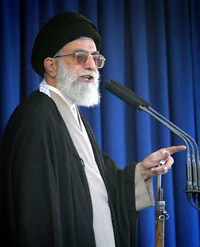
While the Berno saw long service in the Iranian military, it was eventually replaced in the 70s by more modern weaponry within the armed forces. However, many private individuals within Iran, such as tribesmen, farmers, etc. still prized their Bernos (4). The Berno became the weapon of choice for the Iranian Revolutionaries in the 70s, with sharpshooters favoring the Berno above other modern rifles. Due to this popularity of the Berno and the prominent role it played in the revolution, it features in Friday sermons in Iran, with religious leaders keeping the rifle close to their sides. As Ali Parsa states:
Besides the rebels, the Islamic government too had a use for Brno: It was, and is, used in official Friday prayer ceremonies. The speaker is required to have 'the weapon of the day' by his side, according to the tradition of the Prophet (he apparently used a sword). The most likely reason for its use in such ceremonies is that it is long enough for the speaker to hold it like a walking stick while he is standing and preaching. The Mauser brothers would have been happy to hear that their rifle would be considered a 'weapon of the day' a century later. (5)


Photo from Ali Parsa


I hope that this article has shed some light on the scattered, but fascinating history of the Persian Mauser. While sources for its history can be dubious at times, some conclusions on its history can be made by piecing together the material available. There is no doubt that it is weapon that carries reverence inside and outside of Iran, not only for its long history, but for the role it has played in shaping that history, for ill and nill. The rifle itself is truly a masterpiece of craftsmanship and weapon design, and for collectors of older military rifles, it is a prized piece for their collections.

1.) Parsa, Ali. "A Piece of History: Brno, the Persian Mauser". Ali Parsa Personal Website. 10/22/2014. http://www.aliparsa.com/brno/brno.html

2.) Ibid.

3.) Ibid.

4.) Carducci, Bernardino. "98/29 Persian Mauser". Gunscollecting.com. 10/22/2014. http://www.gunscollecting.com/english/long-guns/9829-persian-mauser/

5.) Parsa, Ali. "A Piece of History: Brno, the Persian Mauser". Ali Parsa Personal Website. 10/22/2014. http://www.aliparsa.com/brno/brno.html


Friday, June 14, 2013

Central Eurasia and the Internet: A Love/Hate relationship

I am going to shift gears here with Baby Got Bactria for a moment and take a look at what is going on in Central Eurasia today. One need not search for very long to find news of new laws limiting journalistic powers, penalizing certain forms of free speech, and the blacklisting certain websites in the former Soviet satellite states. This is also seen in Iran and over and down into the Middle East states. Yet even with this suspicion of the internet and its influence, there are also examples of Central Eurasian countries benefiting from its use.  For example, there is a project in Kyrgyzstan to collect a photo archive, accessible to everyone, so people may learn about Kyrgyzstan's history.  There is also the matter of e-commerce in Kazakhstan, an area of potentially incredible growth in the Kazakh economy, yet Kazakhstan cannot seem to keep itself from regulating and restricting information on the internet. 

With these juxtaposing interests of freedom and authority active in the region, I have asked Dr. Joshua I. James of University College Dublin, Ireland and the website Cybercrime Technologies to share his thoughts on the issues facing Central Eurasia in Cyberspace.

BGB: I've read recently that Azerbaijan is considering a new law implementing stiff penalties for profanity and libel on the internet. Such legislation is being decried as a way to curb government critics. While attempts to legislate the internet seem to be in vogue right now, do you find these to be ultimately useless laws, or do you find them to be power-grabs by governments?

JJ: "I think Azerbaijan, like many other countries, are currently going through a period of realization that they don’t understand what this “Internet” thing actually is in terms of the role their government(s) will play in the future. Their natural reaction, as we have seen, is to attempt to impose a local law to something that is really much bigger than themselves. In most cases I don’t think they really care what the law is, as long as they look like they are doing something about the “problem” (locally). Because of the nature of the Internet, a lack of understanding, and a lack of willingness to do research, the majority of laws that are being passed right now are much, much too general, allowing many opportunities for abuse. We’ve seen abuses because of the general scope of laws like the U.S. Computer Fraud and Abuse Act, and the laws that (arguably) less developed democracies are proposing are normally much more general than that – very old - law.
I don’t believe every horrible law that is proposed is meant to be malicious, but is just the product of a person who is ignorant of the area trying to do something good without actually understanding the problem. That being said, with the Internet playing a key role in the Arab Spring, I think that was somewhat a wake-up call to some governments, or organizations within governments. I think many politicians saw a chance to sell cybersecurity as a National Security issue (which security experts have been yelling for years), and gain political power in doing so.
I believe cyber law is mostly, as you say, a power-grab right now. My primary reason for believing this is because countries that are extremely concerned with online profanity are rarely willing to work on the problem at a global level. They want to keep control, or even further oppress, their physical space in digital reality, not actually contribute to fighting a real problem. This tells me that they might actually be concerned with profanity, but they are also looking to abuse the power overly general laws will afford them. Do I think these laws are useless? No... I think they’re terrifying.
However, from what I’ve seen around the world, the people in most countries don’t really care what laws are passed, as long as 1) they don’t have to pay more for the Internet and 2) they think they are not being watched/filtered (I’m over-generalizing). Basically, trying to get people to pay attention to what is happening is impossible until it is far too late. With an attitude like that, power-grabs based around national cyber security are actually pretty effective."

BGB: Also, in relation to the previous question, do you think that hacktivism has become something of a great equalizer, pitting the "little guy" against "big governments"? Or do you feel that this hacktivism is fueling the fires of government calls for restriction of online freedoms and even access?

JJ: "I am quite mixed about hacktivism (again how, exactly, do we define hacktivism). I’m very much an advocate of openness, but not maliciousness. I find some ‘attacks’ where I might agree with the attacker’s sentiment, but completely disagree with the attack they used, or how data or information was used afterwards. In an article about legal protest and distributed denial of service, I tried to make an argument FOR legal civil protest using DDoS, but ultimately couldn’t find a way to justify it. Right now hacktivism, to me, seems more like bullying than communication. However, the bigger problem is that in most cases it is impossible to tell if something is hacktivism or malicious exploitation by criminals. For example, if a bank looses the personal records of 1,000,000 people, it is very hard to say in one case “ah, well they are just standing up for what they believe in – they will delete the data”, and in another “they stole the records to sell on the black market”. One, I can probably agree with, the other should probably be a crime. However, all we know is that the records were stolen, and not how the records will be used. And since hacktivists are usually relatively anonymous, should we actually trust they are using stolen data as they claim? If stolen data negatively affects the people AND the corporations, I don’t think I can agree with it. During protests we should be fighting to make things better for the people. If the people become collateral damage, then the protest is not worth it.
But in those cases, I am referring towards civil complains, not complains against the government. In civil cases, there should be some way to legally protest online. This means that the techniques that are used should be able to be differentiated from malicious hackers. Extreme force is not always necessary to get your point across.
In the case of hacktivism against governments, I think online attacks are becoming somewhat an equalizer. But I also think it is being abused. It is very easy to launch online attacks, and everyone has something to complain about. If hacktivism is always rather extreme, and is used whether it is an amendment violation or a parking violation, then the overall impact will be lessened. This reminds me of physical protests in Korea. Groups here protest different causes literally every day. The result of protesting every day is that the average person becomes desensitized, and quits caring about your cause. This makes groups more radical to get their point across, then people start hating these groups for being insane.
I think in terms of government activism there should be some sort of legalized channel of anonymous online protest, and when that fails, then other – potentially illegal – measures may be necessary in extreme cases. The problem now is that if everyone can launch an online protest, again, how do you differentiate protest from malicious attack when you cant identify the person attacking you. Keep in mind that governments and businesses are pretty much constantly under malicious attack. It would be best if there was a way to organize and control the use of extreme protest methods online, but centralized management is impossible. And you will always have a crazy person that wants to protest pickles on his hamburger by taking down a government website. To these organizations, hacktivism looks just like another malicious attack coming in.
I think in both cases the problem is attribution. Hacktivists would need to differentiate themselves from malicious hackers with some form of identification, and since hacktivsts use illegal methods to get their point across, they don’t want to identify themselves. The result, then, is that organizations can’t tell the difference, so they call for more online restrictions. Again, communication is key, and most hacktivist methods I have seen so far are not really about communication, but showing that they are stronger. And I think intimidation methods hurt everyone in the long run."


Dr. Joshua I. James is a research fellow at UCD Ireland.  He is currently in South Korea working with the South Korean police on cybercrime and investigative methods in digital forensic research.  

Wednesday, May 22, 2013

The Comitatus and Thor

The comitatus in the movie Thor, consisting of (R to L): Thor, Volstagg, Fandral, Sif, Hogun, and Loki.


The concept of the Comitatus is an aspect of martial life that spread across the steppe from China all the way to Europe. Warlike societies, from various Eurasian nomadic groups to the Rus (Vikings), were attested to having their own versions of the comitatus. But what is this comitatus, you ask?  Allow me to elaborate.

The comitatus is discussed at length in Christopher Beckwith's book Empires of the Silk Road. It is a personal guard corps loyal to the leader above all else, including family, government ministers, etc. Beckwith describes the comitatus as "a war band of [the lord's] friends sworn to defend him to the death."(1)  This death not only meant potential death in battle, but also ritual suicide upon the death of the lord. A comitatus could number in the hundreds or thousands, however the core of the comitatus consisted of a small number of the lord's closest personal friends and allies.(2) The comitatus could also include the lord's male relatives or even sons, as Chinggis Khan's sons were among his trusted generals.

There was good incentive for joining a comitatus. The lord was bound to his guardsmen to reward them richly for their service. Gifts of war booty, silks, jewels gold, titles and honors were granted to the comitatus members. Khubilai Khan's twelve thousand bodyguards were gifted robes of silk and gold, adorned with precious gems. This gifting of robes was attested by Marco Polo and said to have happened thirteen times a year, incurring immense cost to Khubilai Khan. "The cost of these robes, to the number of 156,000 in all, amounts to a quantity of treasure that is almost past computation".(3)  However, the cost of disloyalty for members of the comitatus was also steep. Punishment was death, with all property gained in life forfeited.
"According to a story in the Secret History, a comitatus warrior abandoned his defeated Kereit lord, who could no longer provide him with good food, gilt clothing, and high status, and he went to serve the victor - Chinggis Khan - instead. Chinggis rightly declared that the man had abandoned his liege lord and could not be trusted to become a companion; he ordered him to be executed." (4)
Now, what does all of this have to do with the movie Thor? Quite a bit, actually. Upon viewing the movie, I was struck by how aspects of the interactions among Thor, Loki, Sif, Fandral, Volstagg, and Hogun resembled the operations of the comitatus system. There is an argument that could be made that this is the comitatus of Thor, or this could be the comitatus of Odin, in which case Thor and Loki would be a part of their father's comitatus. If the former interpretation is taken, there is eviden to support it. It was not uncommon for princes to start their own comitatus while their lord was alive. This is the case for al-Ma'mun and al-Mu'tasim, two Abbasid Caliphs who maintained a comitatus. Al-Mu'tasim formed his comitatus well before the death of his predecessor, al-Ma'mun.(5)

Looking at the movie, there is much evidence when following the theory that Sif, Fandral, Volstagg, and Hogun are Thor's personal comitatus. They wear fine armor, wield incredible weapons, dine with the royal family and live in the palace. They accompany Thor on his journeys, even when they know their actions will be met with disapproval by Odin. When Thor is cast out of Asgard, they seek to intercede on his behalf with Odin, and later, Loki. When these paths fail, they go to Earth themselves to rescue Thor. When fighting the Destroyer in New Mexico, Sif declares she will die a warrior's death when Thor asks her to flee to safety. She only defers to Thor's will when he informs her he has a plan to defeat the Destroyer. Upon their return to Asgard, they are treated as heroes with a grand celebratory feast hosted by Odin and his wife, Frigga.

There is also some evidence that Thor and Loki, along with the others, could constitute the comitatus of Odin. The King and Queen are the patrons of all of them, granting them all of their weapons, wealth, status, and power. Perhaps the most interesting evidence is when Odin cast Thor from Asgard for disobedience. This is an action not unlike executing or banishing a disloyal comitatus member. Stripped of his land, powers, and titles, Thor is exiled to Earth while Loki becomes the king of Asgard. Also interesting is how Loki chose to die (or later, it is revealed he has been transported to another part of the universe) rather than live in his brother's shadow and live as a disloyal outcast of the royal family.

Of course, this is not a perfect example of a comitatus. Thor was not executed for his disobedience, nor were his comitatus companions punished for following Thor into the Jotunheim.  However, the elements are there, and it makes complete sense to incorporate the comitatus, which was an attested aspect of Viking life, to the world of Asgard and its inhabitants.


1. Beckwith, Christopher I. Empires of the Silk Road: A History of Central Eurasia from the Bronze Age to the Present. (Princeton University Press: 2009) pg.12.

2. Ibid, 13

3. Latham Richard trans. Marco Polo: The Travels ( Penguin: 1958) pg. 138, 140-141, quoted in Christopher I. Beckwith. Empires of the Silk Road: A History of Central Eurasia from the Bronze Age to the Present. (Princeton University Press: 2009) pg.22.

4. Allsen, Thomas T. Commodity and Exchange in the Mongol Empire: A Cultural History of Islamic Textiles. (Cambridge: 1997) pg. 53 quoted in Christopher I. Beckwith. Empires of the Silk Road: A History of Central Eurasia from the Bronze Age to the Present. (Princeton University Press: 2009) pg.17.

5. Beckwith, Christopher I. Empires of the Silk Road: A History of Central Eurasia from the Bronze Age to the Present. (Princeton University Press: 2009) pg. 25.

Friday, April 12, 2013

Snake and Bake

While visiting the St. Louis Zoo on a family vacation, I noticed three snake species in the Zoo's Herpetarium that were particularly relevant to my interests.  They were as follows:

The Armenian Viper

Information about the Armenian Viper
The Armenian Viper is, according to the St. Louis Zoo website, a venomous snake native to Armenia and its surrounding areas.  They are found in mountainous areas, where they feed on insects, rodents, and lizards.  They share dens with other vipers in the winter where they hibernate during the cold months.  An interesting fact about these vipers that the Zoo's website relates is that they give birth to live young rather than laying eggs. (1)

Iranian Mountain Viper

Information on the Iranian Mountain Viper
According to the St. Louis Zoo's information card, the Iranian Mountain Viper is found only in Zanjan Mountain range, near the Caspian Sea, at elevations of 8,000 feet.  The Viper is vulernable due to over-collection for antivenom production. (2)

The Caucasus Viper

Information on the Caucasus Viper

The Caucasus Viper, according to the St. Louis Zoo website, is a vulnerable species of viper found in the mountainous areas of Turkey and Russia.  Because of political unrest, over-collection, and habitat destruction, conservation efforts for the snake have been frustrated in this area of the world.  Little is known about this snake due to the harsh climate that it inhabits. (3)

These are but a few of the many Eurasian species present at the zoo. I would encourage all my readers to visit the St. Louis Zoo's Center for Conservation in Western Asia website and check out their efforts to save various Central Eurasian species from the brink of extinction.


1.  St. Louis Zoo: Armenian Viper.  http://www.stlzoo.org/animals/abouttheanimals/reptiles/snakes/armenianviper/. Date Accessed: 04/12/2013

2.  St. Louis Zoo information card.  St. Louis Zoo Herpetarium.

3.  St. Louis Zoo: Caucasus Viper.  http://www.stlzoo.org/animals/abouttheanimals/reptiles/snakes/caucasusviper/. Date Accessed: 04/12/2013